The Piandarca Shrine
THE PIANDARCA SHRIRE
The Historical Path ends at the side of a shrine erected in 1926 by a family of Cannara for grace received.
Sculptor Bruno Bini from Cannara, along with the Perugian painter Castore Vignaroli developed the Piandarca Shrine, built to commemorate the seventh Centennial of the death of St. Francis.
It is a “small votive brick building nestled among oaks and cypresses, which contains a fresco of St. Francis surrounded by birds: the painting is protected by a rather protruding wooden roof.
All around there are decorative inserts of terracotta worked in relief. In front of the Shrine, on brick piers, is the altar slab “(G. Sergiacomi).

From Saint Francis Forest to Piandarca- the Project
From Saint Francis Forest to Piandarca- the Project
From Saint Francis Forest to Piandarca- the Project
A pedestrian and cycling route that connects Assisi, Santa Maria degli Angeli and Cannara
Specially tracked, reported and geo-referenced,
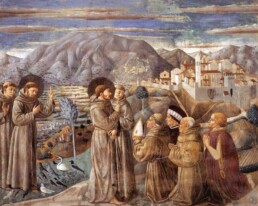
the route connects the Upper Basilica of Assisi, passing through the Bosco di San Francesco, to Piandarca and the Historic Path. The itinerary, of about 15 km, passing through Santa Maria degli Angeli, ideally joins Giotto’s pictorial representation of the Sermon of San Francesco to the birds, to the place that was the scene of the famous idyll.
The excellent ranking in the FAI contest ‘I Luoghi del Cuore’ (Places to love) – has allowed Piandarca to access the tender for the assignment of contributions to worthy projects that FAI promotes every two years to the results of each Census.
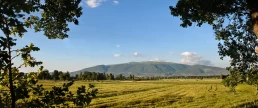
The project “From St. Francis Forest to Piandarca and the Preaching to the Birds” consists of the identification and creation of a georeferenced, plotted, and signposted cycling and walking route. It links the Upper Basilica of St. Francis in Assisi – passing through St. Francis Forest (FAI property) – to Piandarca and the Historic Path, and is equipped with special signs and information totems with QR codes that, with a simple smartphone, allow visitors to connect with a portal dedicated to Piandarca receiving information on the itinerary and the place.
This nature itinerary reunites Giotto’s pictorial representation of the Preaching to the Birds to the place where the episode took place, passing through the enchanting landscapes of Assisi countryside.
Associated technical-practical solutions:
The identification of the site as a point of interest in common navigation systems; the marking of the main area with an element of high symbolic value and zero environmental impact, a TAU created through a diversified mix of vegetation and facing towards Assisi; the planting of indigenous trees and simple resting structures to recreate a symbolic and meditative space, the graphics of a Piandarca brand for the immediate and unambiguous identification of the place; the construction of a dedicated site.
The launch of the project was announced on a highly symbolic date 4 October 2016 –Feast of St. Francis – with a dedicated presentation held in Cannara at the Auditorium San Sebastiano, illustrated by Lawyer Fabrizio Gareggia, Mayor of Cannara, through a story made of images and sounds.
The Mayor then revealed the most symbolic element: the specially designed logo, which will make Piandarca instantly recognizable; it is an image of great beauty and significance inspired by the famous fresco by Giotto. ‘In addition to the quality and innovativeness of the elements illustrated, the great value of the project lies in the support of the subjects we have involved for their prestige and their natural vocation to share its universal content. A synergy that we strongly wanted, because sharing and collaboration are the elements that can give strength to a project’.
Among the participants in the presentation of the project, Nives Maria Tei Coaccioli, President of FAI Umbria and, representing Banca Intesa Sanpaolo, Alberto Baldelli, Retail Area Director of Perugia.
During the beautiful evening, the arrival of Fr. Mauro Gambetti, Custos of the Sacred Convent of Assisi, was very welcome, there was a joyful exchange of gifts between the Mayor of Cannara, and the Custos of the Convent of Capuchins of Monterosso, Fr. Renato Brenz Versa, accompanied for the occasion by the Mayor of Monterosso, Emanuele Moggia.
Places of the Heart - FAI (Fondo Ambiente Italiano)
Despite the high historical, spiritual, cultural, naturalistic value and the universality of the message it expresses, Piandarca has not received adequate protection over time and its integrity has been repeatedly put at risk.
Its strong roots in the popular heart, however, have prevented such dangers through the work of a Committee set up for its protection which has, among other things, promoted participation in the 7th edition of ‘I Places of the Heart’. the census of Italian places promoted by the FAI in collaboration with Intesa Sanpaolo – in which Piandarca ranked 10th, with 22,888 reports collected and with the support of the Municipality of Cannara, the Parish of Saints Matteo Apostolo and Giovanni Battista, ‘SFO local and regional, of the Pro Loco, of numerous volunteers.
An important milestone that has allowed Piandarca to return to shine with a new light thanks to the FAI and its work of recovering forgotten places, but live in the hearts of Italians.


The Memorandum of Understanding
The Memorandum of Understanding
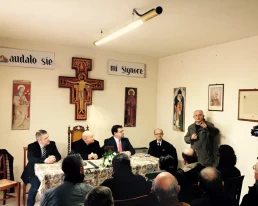
The project 'From the Forest of St. Francis to Piandarca and the Path of Preaching to the Birds' is the concrete result of an intense work that comes from afar and finds its salient moment in the 'Memorandum of Understanding' dedicated to the protection and enhancement of Piandarca. It was signed on January 14 2015 between the Municipality of Cannara, the City of Assisi, the Diocese of Assisi-Gualdo Tadino-Nocera Umbra, and the OFS Umbria, whose content received morally the paternity of the Sacred Convent of Assisi.


The signing of the ‘Memorandum of Understanding’ - which aims to undertake a common path of protection and enhancement of the place of the Preaching to the Birds-, is an act of great importance, a historic moment. This is the first formal recognition of Piandarca as a Franciscan place, of the immense historical, spiritual, cultural, and landscape heritage that it has been silently guarding for centuries. A universal message whose value crosses local borders to belong to humanity. This historic document represents the first recognition of the importance of Piandarca by the institutions: a goal that no one would have hoped for and achieved thanks to the commitment of people respectful of an exceptional place that can now finally open up to the world.
The Franciscan Places
The Franciscan Places
In the historic centre of Cannara, there are several places where the tradition of the Third Order institution is still alive.

THE CHURCH OF THE GOOD DEATH
Located on the Square now named after the Third Franciscan Order. It was erected on a small Oratory of the 12th century, the same one in which according to tradition St. Francis created the Third Order in 1221 and where he gave the Franciscan habit to BL. Lucio from Cannara, the first Franciscan Tertiary.
THE CHURCH OF ST. FRANCIS
It overlooks the Square now named after St. Francis of Assisi. The Tertiaries of Cannara built it in the early 1600s. Above the church portal is the coat of arms, carved in stone, of the Conventual Fathers of Assisi and, below, the following inscription (translated from Latin): Consecrated to the divine Francis who in this castle before elsewhere instituted the Order of the Secular Penitents.
The inscription refers to the event of 1221, the concession of the grey habit to Bl. Lucio Modestini of Cannara.
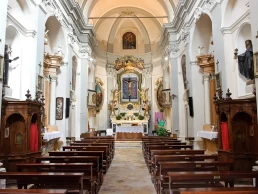
The interior, consisting of a single room with an adjoining sacristy (formerly the meeting place of the Franciscan Tertiaries), has a high altar and two lateral ones. The main one is surmounted by a canvas by Cesare Sermei, an Umbrian painter of the seventeenth century, depicting the dressing of a Tertiary by St. Francis.


THE HOVEL
Located inside the Landrini- Majolica Palace, today the regional headquarters of the Franciscan Secular Order, this hovel is included in the original hospice for pilgrims and here the Saint dwelt in rest and prayer when passing through the land of Cannara.